|
Hi, I am a tenure-track Associate Professor at Shanghai Jiao Tong University. Previously, I was a postdoctoral fellow in the Department of Biomedical Informatics at Harvard University, working with Prof. Pranav Rajpurkar. I completed my Ph.D. at Shanghai Jiao Tong University and my B.S. at the School for the Gifted Young, University of Science and Technology of China. I am interested in building predictive AI models of the cell — closed-loop with simulation and experiment — to accelerate the discovery of new medicines and narrow the gap between biology and patient impact. Google Scholar / Github / LinkedIn / Twitter |

|
Recent News
Congratulations to all co-authors on the following acceptances, and thank you for the excellent teamwork!
[10/2026] 1 paper has been accepted by Nature Chemical Biology (IF: 15.8).
[08/2026] 1 paper has been accepted by Nature Reviews Computing.
[07/2026] 1 paper has been accepted by Radiology: Artificial Intelligence (IF: 20.1).
[07/2026] 1 paper has been accepted by Nature Machine Intelligence (IF: 29.8).
[07/2026] 1 paper has been accepted by MLHC 2026.
[06/2026] 1 paper has been accepted by NEJM AI.
[04/2026] 1 paper has been accepted by CHIL 2026.
[04/2026] 1 paper has been accepted by JACC (IF: 22.3).
[03/2026] 1 paper has been accepted by Nature Medicine (IF: 52.5).
[03/2026] 1 paper has been accepted by MIDL 2026(Oral).
[02/2026] 1 paper has been accepted by Nature (IF: 56.1).
[12/2025] 1 paper has been accepted by JBHI (IF: 6.8).
[12/2025] 1 paper has been accepted by NEJM AI.
[11/2025] 1 paper has been accepted by Machine Learning for Health (ML4H) 2025.
[09/2025] 1 paper has been accepted by Radiology (IF: 17.6).
[09/2025] 3 papers have been accepted by Pacific Symposium on Biocomputing (PSB) 2026.
[09/2025] 2 abstracts have been accepted by 2025 RSNA Cutting-Edge Research Abstracts.
[09/2025] 1 paper has been accepted by Nature Scientific Data.
 Datasets & Benchmarks
ReX-MLE: A medical ML benchmark for evaluating automated AI agents on realistic medical imaging tasks. ReXGradient-160K: A large-scale publicly available dataset of chest radiographs with free-text reports 3DReasonKnee: A 3D Reasoning Benchmark for Knee MRI ReXGroundingCT: A 3D Chest CT Dataset for Segmentation of Findings from Free-Text Reports ReXRank: A Public Leaderboard for AI-Powered Radiology Report Generations RadGenome-ChestCT: A grounded vision-language dataset for chest CT analysis PMC-VQA: A large-scale, high quality question answering benchmark for chest X-rays
Selected Research
See the full publication list for all papers.
|
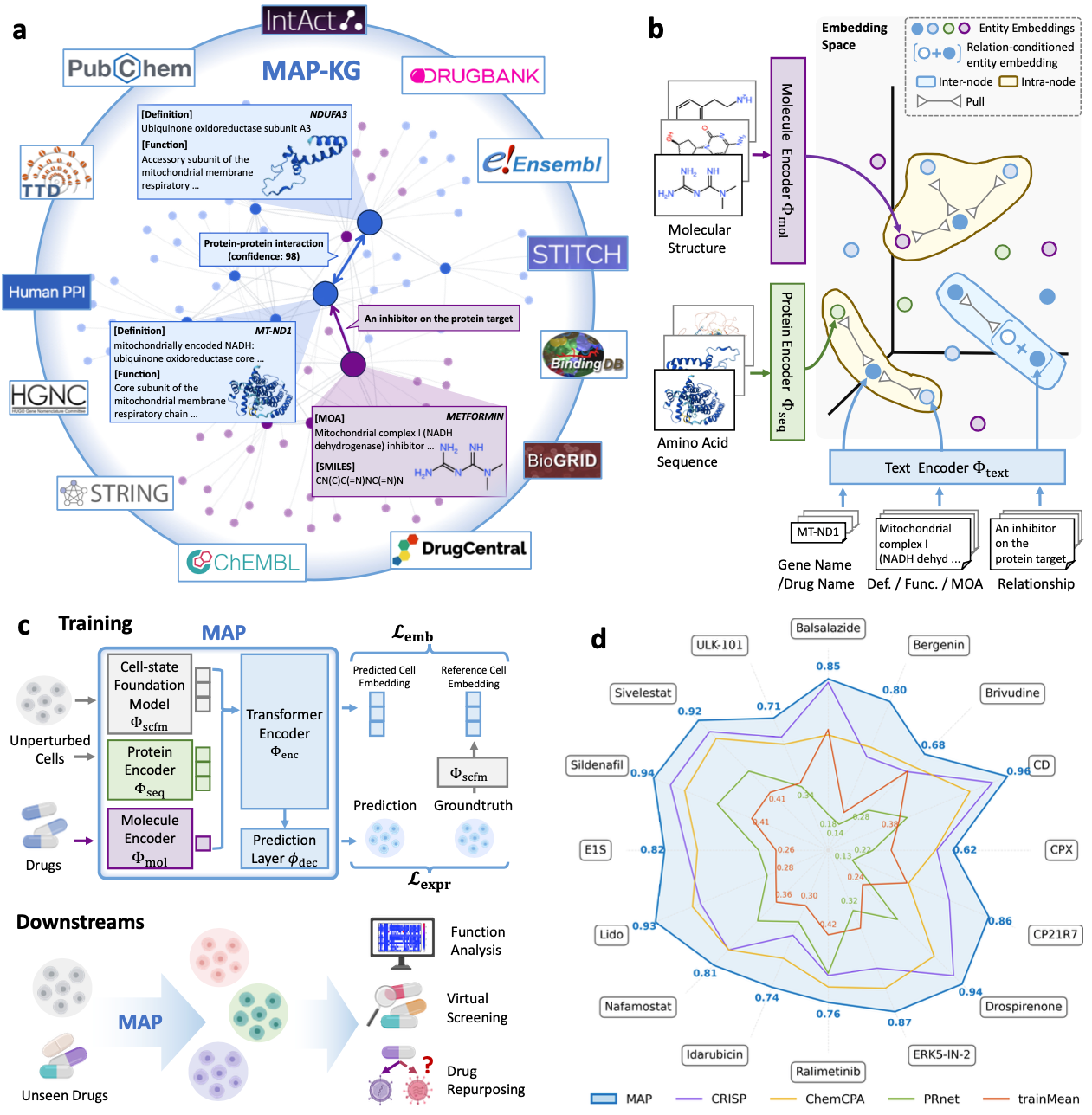
MAP: A Knowledge-driven Framework for Predicting Single-cell Responses for Unprofiled Drugs Nature Machine Intelligence (IF: 29.8)
Most existing models for predicting drug-induced single-cell responses fail to generalize beyond their training compound set, limiting in-silico screening to a narrow chemical space. MAP introduces a knowledge-driven framework that grounds predictions in molecular structure and biological pathway priors, enabling transcriptomic response prediction for drugs never seen during training. This opens the door to systematic in-silico screening across novel chemical libraries — a key step toward predictive, simulation-driven drug discovery.
|
|
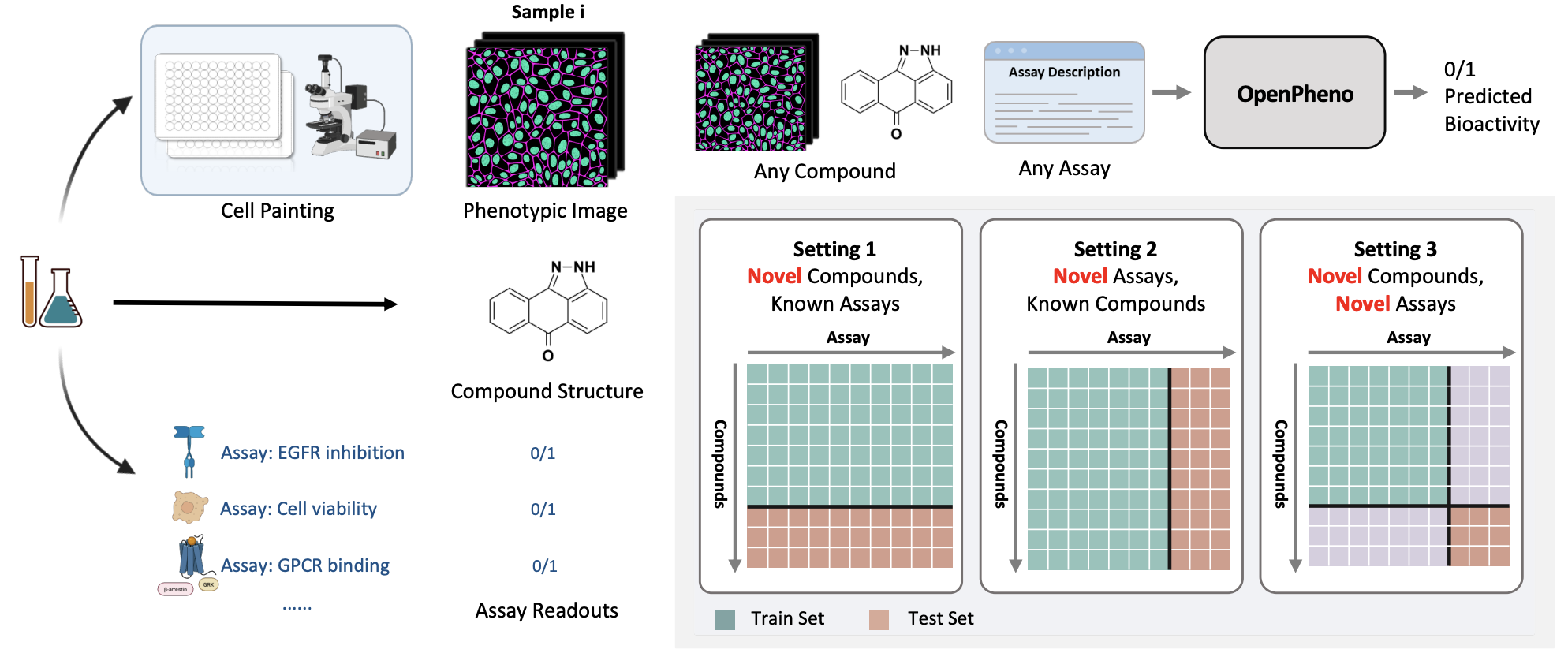
Phenotypic Bioactivity Prediction as Open-set Biological Assay Querying Nature Chemical Biology (IF: 15.8), in press
Phenotypic compound profiling is fundamentally open-ended: each new biological assay defines a new target space that models trained on fixed assay panels cannot handle. We reformulate phenotypic bioactivity prediction as an open-set retrieval problem in which assays themselves are treated as queryable entities. The resulting framework generalizes to unseen targets and assays, enabling scalable, hypothesis-free compound profiling at the scale needed for real-world screening campaigns.
|
|
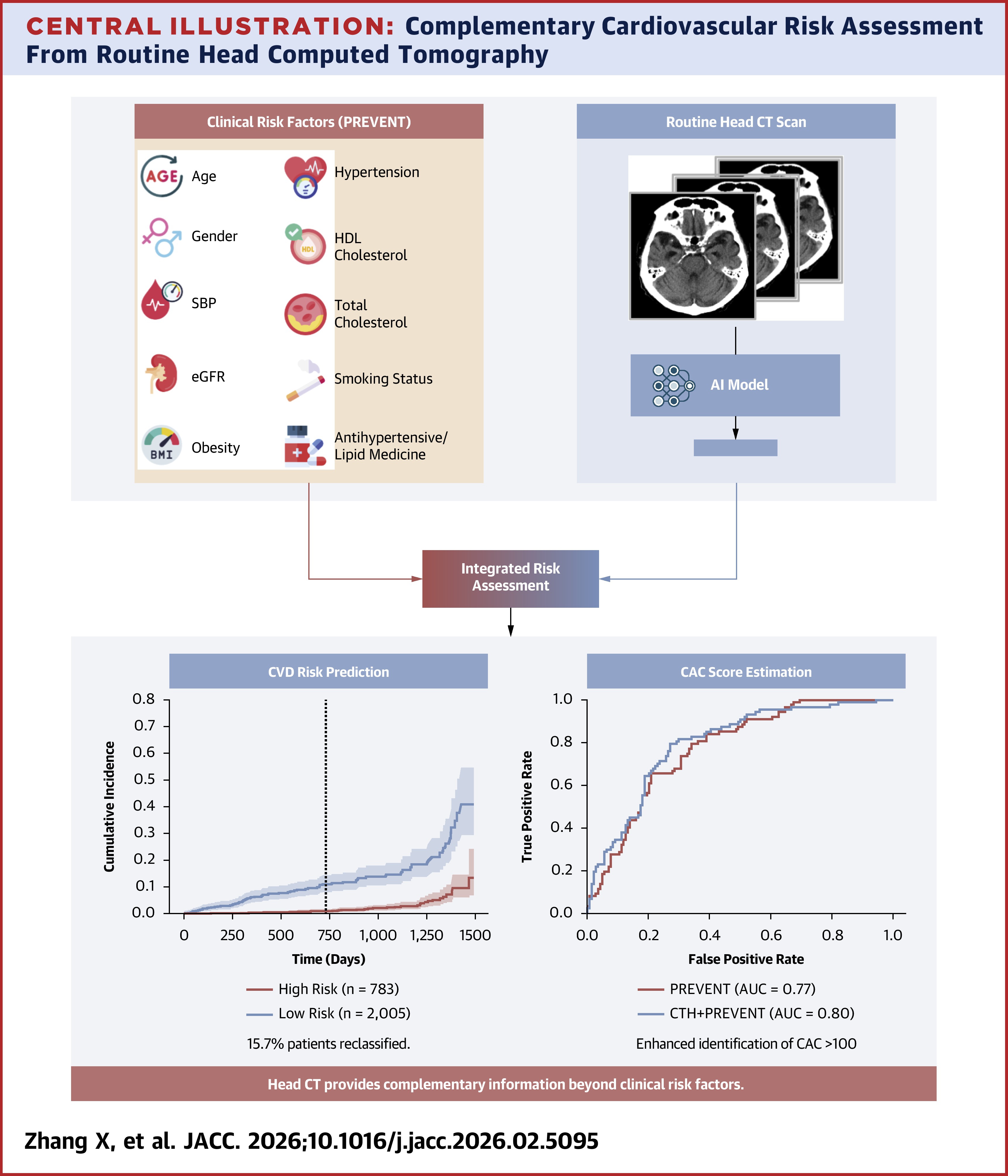
Opportunistic Cardiovascular Risk Assessment Using Routine Head CT in the Emergency Department JACC (IF: 22.3), 2026
Cardiovascular risk is often discovered only after an acute event, even though millions of emergency-department patients receive head CTs each year for unrelated reasons. We show that these routine, "opportunistic" head CTs contain rich vascular calcification signals that AI can extract to stratify long-term cardiovascular risk. This enables early identification of high-risk patients — and personalized prevention — without any additional imaging, radiation, or cost to the patient.
|
|
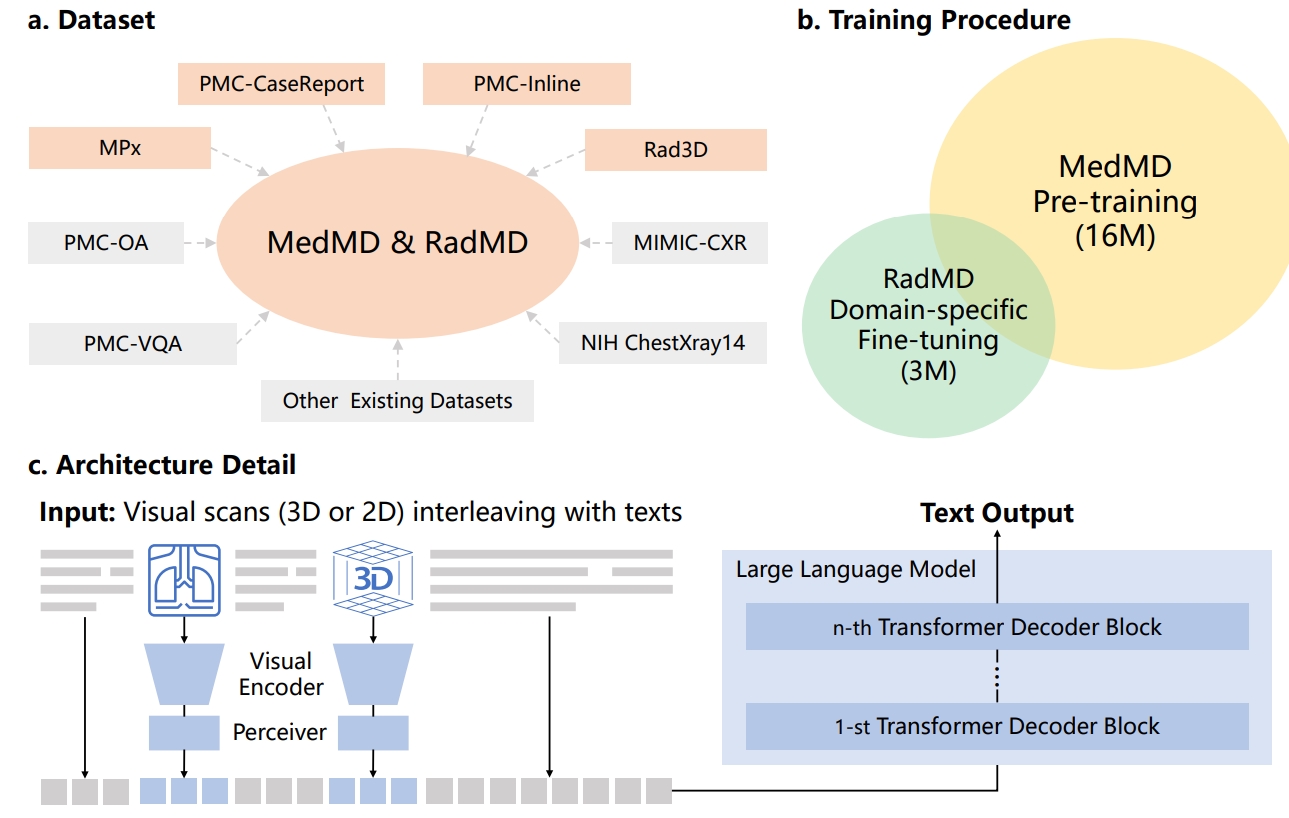
Towards Generalist Foundation Model for Radiology by Leveraging Web-scale 2D & 3D Medical Data Nature Communications, 2025
Despite the success of foundation models in general vision and language, radiology has remained fragmented across modality- and task-specific systems. We introduce RadFM, a generalist radiology foundation model trained on web-scale 2D and 3D medical data spanning X-ray, CT, and MRI. A single unified architecture handles diverse tasks — VQA, report generation, diagnosis, and visual grounding — across modalities, taking a step toward generalist medical AI that scales with data rather than task-specific engineering.
|
|
Based on a template by Jon Barron.
|